Sol LeWitt
The early 1960s was a pivotal moment for Sol LeWitt, as the artist experimented with the foundational themes of his art: sequence, seriality, the union of word and image, and three-dimensionality. Opening on January 15th, Sol LeWitt: Works from the 1960s will trace the development of these guiding principles, paying special attention to the transition from figuration on a flat painted plane to seriality in three-dimensional structures and wall drawings.
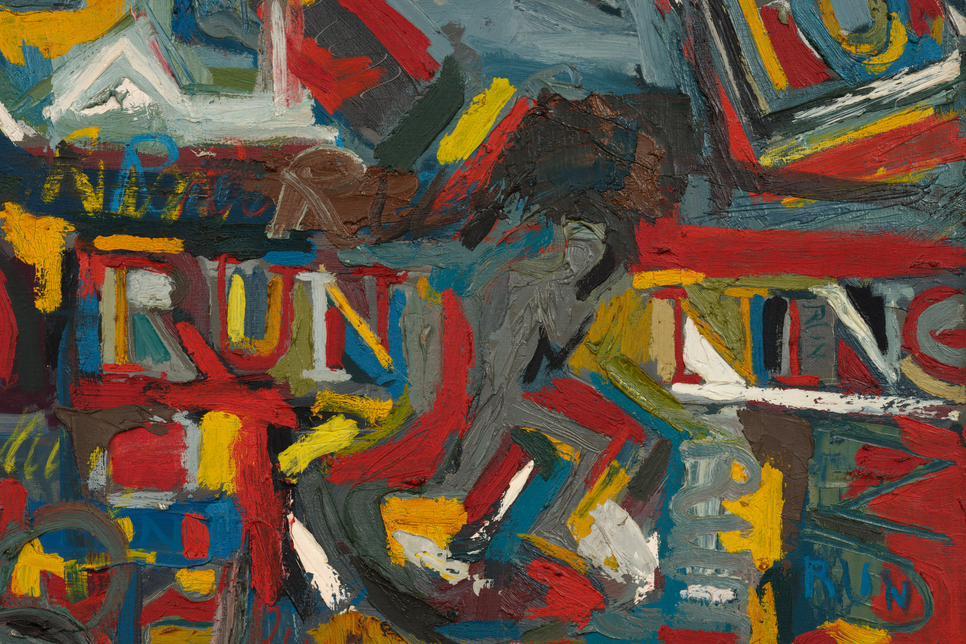
A number of works in the exhibition depict human figures in motion, revealing the influence of Eadweard Muybridge’s sequential photographs of people walking, jumping, and climbing on the formation of LeWitt’s conceptual approach. Among these are the remarkable Run series of large-scale paintings and painted reliefs that borrow directly from Muybridge’s photographic composite Running at full speed, 1872-1885. Figure studies for this body of work on canvas and paper lay bare LeWitt’s process: “I knew that there was something there that was important to me, but I didn’t know how to use it.”[1]
By the late 1960s LeWitt had identified serial modular structures as a system for the physical manifestation of his ideas, establishing a creative process of profound rationality and originality. LeWitt also developed his Drawing Series system using straight lines in multiple, infinite combinations and executed his first wall drawing at Paula Cooper Gallery in 1968, an adaptation of this system drawn by hand directly on the wall.
The exhibition will include Modular Cube, 1966, which was included in the influential Primary Structures exhibition at the Jewish Museum that year, as well as works from LeWitt’s first one-person show in 1965 at the John Daniels Gallery, a short-lived experimental space operated by Dan Graham.
A major exhibition of LeWitt’s work will also be on view at the Museum of Contemporary Art Tokyo (MOT) from December 24, 2025 – April 2, 2026. Titled Sol LeWitt: Open Structure, this exhibition marks the first significant presentation of his work at a public museum in Japan.
[1] Andrew Wilson, 'Interview with Sol LeWitt', Art Monthly, March 1993